Unpacking the complexity of measurement informed inventories and building more defensible methods for methane reporting
Background
The discovery of the top-down, bottom-up gap in methane emissions from oil and gas infrastructure marked the beginning of a new era in measurement, estimation, and regulation. Aerial and satellite remote-sensing technologies revealed a substantial difference between the amount of methane emitted from facilities, sites, or entire regions and the amount detected through traditional source-level inventories based on engineering calculations and emission factors.
Research has established that in most cases the bottom-up approach does not provide an accurate model of the reality of methane emissions. Several studies have documented considerable disagreements between traditional methane inventories and estimates of emissions generated by vehicle, aerial, and space-based remote sensing. An aerial campaign in the Permian Basin (measurements collected 2018 to 2020) found a 6.5 times discrepancy in the New Mexico Permian Basin,1 and campaigns in Alberta and British Columbia (2021 and 2019, respectively) found discrepancies of 1.5 times and 1.8 times.2,3
The methodology of measurement informed inventories (MIIs) was developed to help companies address this gap between real and traditional emissions estimates. But the MII process is still in development and there is no universally accepted, step-by-step approach for building this kind of inventory. The lack of consistency creates challenges for operators in terms of execution as well as comparability of outputs.
The concept is relatively straightforward: measure emissions using different technologies and at different scales, compare the results, and then consolidate a more accurate inventory. In practice, however, building a defensible MII is a complex undertaking that varies considerably from one operator to the next because companies have unique asset bases, data structures, technology mixes, organizational cultures, and approaches to reconciliation analysis.
Voluntary initiatives, such as the United Nations Environment Programme’s Oil and Gas Methane Partnership 2.0 (OGMP), the MiQ Standard, and GTI Veritas, were created to encourage operators to incorporate direct measurements into their methane inventories. But these standards are vague about key stages in the process, such as how the reconciliation analysis between different measurements and time scales should be performed. It’s difficult to meaningfully compare one inventory to another when companies apply diverging methods.
The lack of industry alignment is becoming more apparent as governments and regulators look for credible emissions numbers to support policy goals. The Colorado Department of Public Health and Environment, for example, has taken methane measurement seriously as part of its broader greenhouse gas reduction strategy, including targets under HB-19-1261 to cut overall emissions by 50 per cent by 2030 and 90 per cent by 2050.
By understanding the layers of complexity involved in building MIIs, operators can refine their methods and develop more defensible methane inventories that better support reporting, compliance, and mitigation.
The diverse components and complexity of MIIs
Measurement-informed inventories rely on technology deployment, data integration, statistical analysis, and contextual understanding. The detection component features aerial, satellite, and ground-based technologies to identify emissions across equipment, facilities, sites, and entire regions. The data component deals with the challenge of managing and combining site lists, source categories, naming conventions, and merging with other datasets. The analysis component involves reconciling different emissions estimates, extrapolating short-duration measurements into annual estimates, and calculating uncertainty. Finally, the business and operations component shapes how a company manages methane and coordinates their internal teams. Including more context allows for operational and root-cause information so companies can understand not just the amount of emissions but where and why they occurred.
Detection component
It’s better to be roughly correct than precisely wrong when it comes to estimating methane emissions. The rule of thumb reminds operators that imperfect measurements capturing what’s really being emitted, including rare but large events, are more reliable than engineering calculations and emission factors that can be pinpointed to several decimal places yet miss reality by a wide margin.
Rigorous MIIs must include both wide and narrow aperture measurements. Top-down technologies survey more sites and areas much faster than granular, single-component level measurement on the ground at a facility. Early methane inventories were based on only a handful of these direct measurements. Nowadays operators achieve sampling on the order of 1000s and 10s of 1000s. A study published in Nature in 2024 used nearly one million aircraft-based site measurements to estimate methane emissions from US oil and gas infrastructure.4
If a company increases the number of measurements, they inevitably detect more emissions. The more they pull up the rug, the more they’re going to find. Regulators need to find ways to incentivize taking more measurements without penalizing companies for being proactive. A small proportion of a company’s sites can generate an immense share of their emissions. The study from Nature found that in the Permian Basin almost a third of emissions were created by 0.1 percent of sites.
Another challenge for operators is that the manifold technologies used to generate an MII are at various stages of maturity. Whether it’s an aircraft taking snapshot measurements or a camera-based continuous monitoring device, each technology has its own strengths and limitations. These devices are also impacted by the weather and other geographic factors. The same technology deployed under different environmental conditions can yield different results.
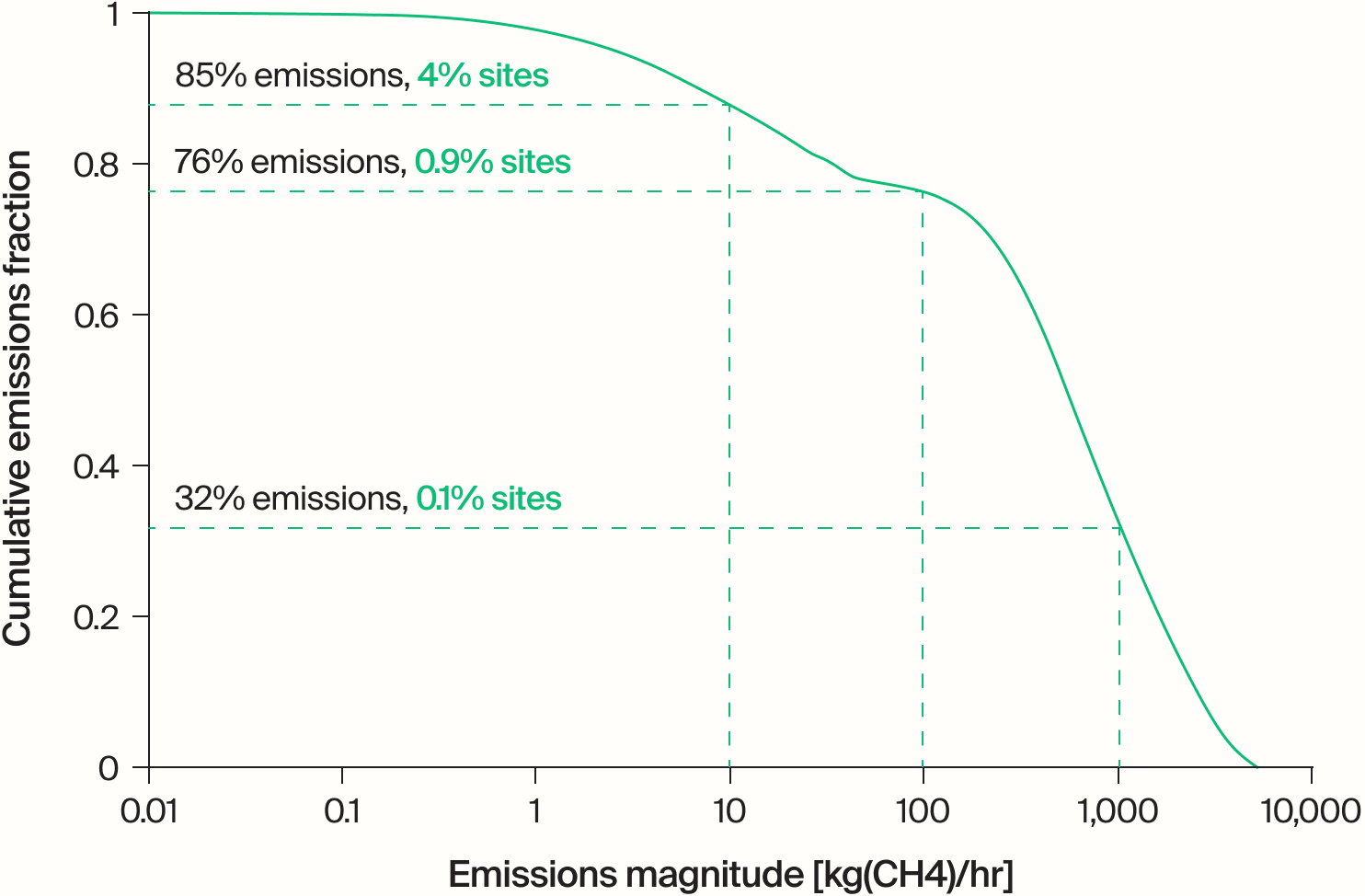
Illustrative plot showing how a small proportion of emissions events and emitting sites can account for a large share of total emissions. Data are based on Sherwin et al.,4 using 2019 Carbon Mapper measurements from the Permian Basin. This figure was generated from a subset of model realizations to illustrate the concept and may not directly reproduce the results reported in the paper.
Data component
Companies may produce different methane emissions estimates depending on which assets are included, which methods are used, and what purpose the inventory is meant to serve. For example, a regulatory inventory may estimate emissions across all reportable sites, while a measurement program may collect data from only a subset of those sites. Operations teams often maintain a separate inventory for leak detection and repair, which includes a list of component inspections and repair records. Measurement-informed inventories often require companies to bring together datasets that were not originally designed to integrate.
These lists may come from separate systems, use different naming conventions, or be incomplete compared with a master site list maintained elsewhere. The same problem can apply to how emissions sources, source categories, or root causes are tagged across datasets. On their own, these inconsistencies may seem minor but when a company tries to scale measurement-informed inventory work across multiple business units, they can create significant data management challenges.
In March 2026, Highwood Emissions hosted a two-day forum in Houston, Texas on innovation and methane emissions management.5 The 60 attendees from more than 30 oil and gas companies represented domestic and international operations in production, transmission, distribution, and LNG.
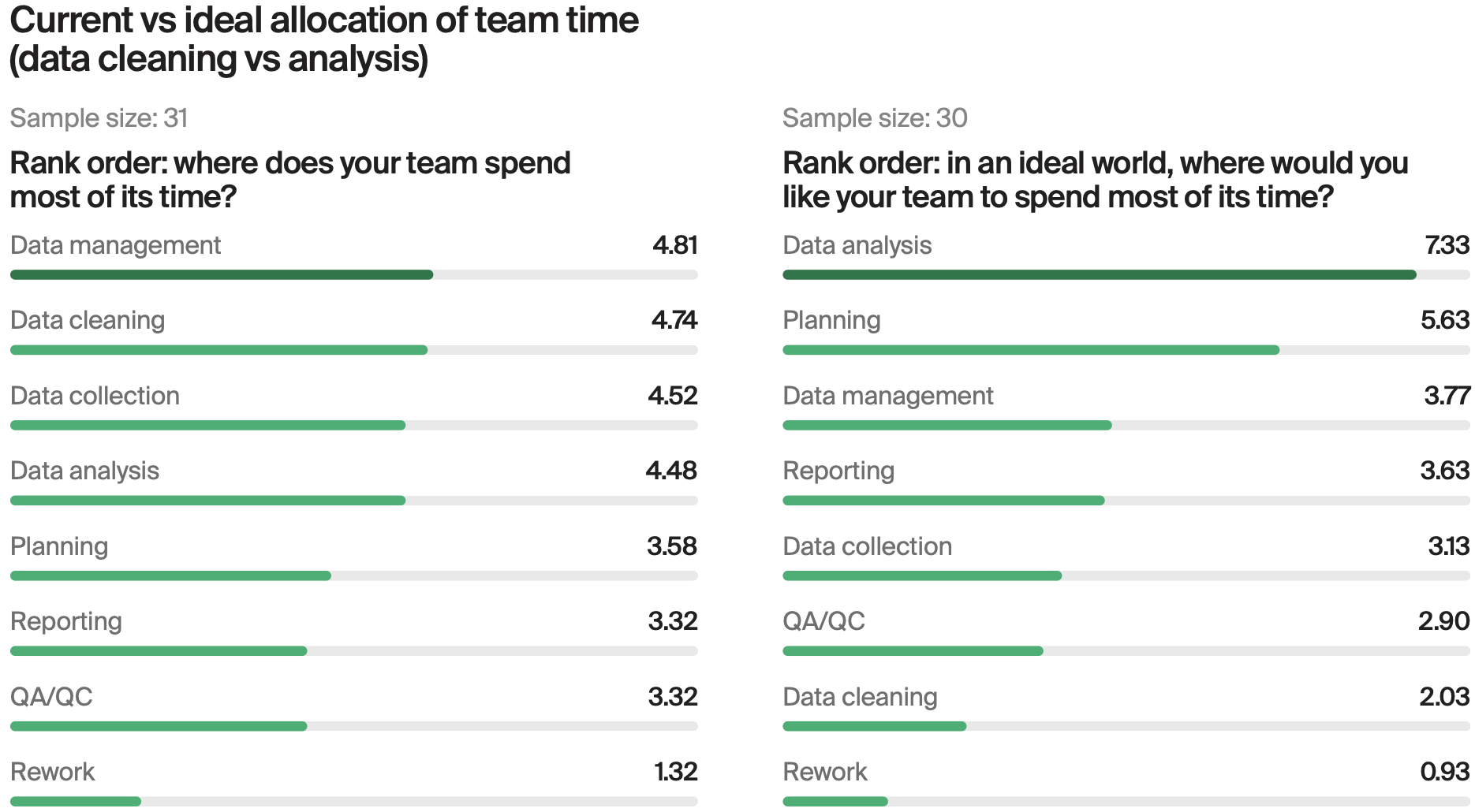
Highwood Emissions Management, Innovation Report 2026 (March 2026)
Analysis component
Reconciliation is the process of comparing two or more emissions estimates and investigating why they differ.6 This often means comparing a company’s traditional bottom-up inventory with estimates generated from top-down technologies, such as aerial surveys, satellites, and drones.
One challenge for oil and gas operators is that there is no single, universally accepted definition in the academic literature for how reconciliation analysis should be done. Different agencies, researchers, and industry groups are still working through the best methods that allow operators to demonstrate low or improving emissions performance. At the same time, regulators are looking for ways to verify and enforce better emissions targets in their jurisdictions.
Methane measurements are often short-duration snapshots. For example, a remote-sensing campaign might survey a facility once or twice a year. An aerial survey captures emissions at specific times, but companies need to create emissions estimates for an entire year. That means analysts must extrapolate from point-in-time or seasonal measurements. This process is complicated by the fact that methane emissions are often unevenly distributed. A relatively small fraction of sites can be responsible for a disproportionate share of total emissions.
Reconciliation methods need to account for both measured and unmeasured sources, including sites that were not sampled during a campaign. Publicly available data from sources such as Carbon Mapper or MethaneSAT can be included, adding another layer of information that needs to be interpreted.
As a result, measurement-informed inventory programs often require advanced statistical work. This can include imputing missing data, extrapolating results to unmeasured sites and times of the year, estimating total annual emissions, and calculating uncertainty. These are not always skills that exist within the team responsible for a company’s emissions reconciliation analysis. The challenge is not only collecting better methane data, but also having the technical capacity to interpret and present that data in a defensible and consistent way.
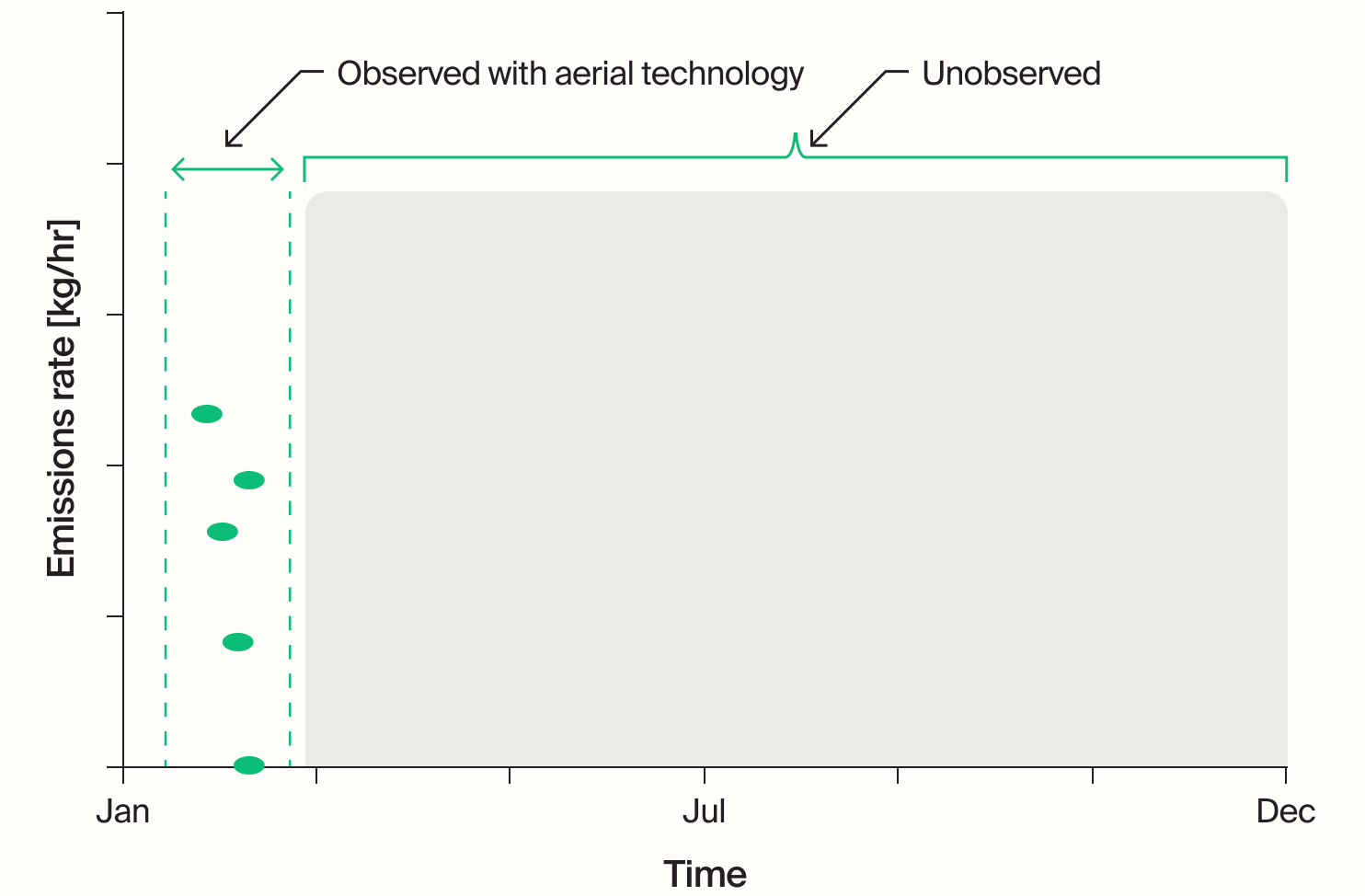
In MIIs, short duration measurements must be used to infer emissions during unobserved periods throughout the year.
Business and Operations Component
Part of the goal of the MII exercise is to arrive at a more accurate estimate of total emissions. Another goal is to better understand where and how the emissions are generated. Finding answers to these types of higher order questions requires incorporating the MII process into regular business operations. It means including operations logs and data sets as well as contextual information from the field.
There’s a consensus within the industry that MIIs should incorporate more context and root-cause data into the reconciliation process. Emissions from a storage tank, for example, can have multiple possible causes. It could be routine venting or it could be an open thief hatch or a malfunctioning pressure-release valve.
Operational context is important because it helps analysts decide whether a measurement represents typical performance or an unusual event. Understanding the context can help turn a detected emission into an explanation, and that explanation is what allows companies to improve estimates, reduce uncertainty, prioritize repairs, and demonstrate whether emissions performance is actually improving.
Conclusion
The application of new technologies, such as aerial and space-based remote sensing, has produced a step-change in our understanding of methane emissions. At the same time, these advancements have introduced new challenges in developing credible measurement-informed inventories. The industry has made initial progress in what will be a long and iterative journey.
Many of the technologies are undergoing rigorous testing, and each has its own strengths and weaknesses. A key challenge is to figure out how to combine multiple technologies in a way that produces more accurate estimates of total emissions. This process is complicated by the fact that current standards are vague about how these calculations should be performed. Operators conduct reconciliation analysis in different ways, making it harder to compare one MII to another.
Highwood Emissions’ role as industry’s independent partner on methane is to help close the gap between complexity and concrete action. A practical approach to the challenge of MIIs is to start with a few technologies, incorporate them into the inventory, and then improve on the process year by year. MIIs are not a one-time calculation, but rather an ongoing commitment to learning, refinement, and improvement.
References
- Chen, Yuanlei, et al. “Quantifying Regional Methane Emissions in the New Mexico Permian Basin with a Comprehensive Aerial Survey.” Environmental Science & Technology, vol. 56, no. 7, 2022, pp. 4317–4323. https://doi.org/10.1021/acs.est.1c06458.
- Conrad, Bradley M., et al. “A Measurement-Based Upstream Oil and Gas Methane Inventory for Alberta, Canada Reveals Higher Emissions and Different Sources Than Official Estimates.” Communications Earth & Environment, vol. 4, 2023, article 416. https://doi.org/10.1038/s43247-023-01081-0.
- Johnson, Matthew R., David R. Tyner, and Bradley M. Conrad. “Origins of Oil and Gas Sector Methane Emissions: On-Site Investigations of Aerial Measured Sources.” Environmental Science & Technology, vol. 57, no. 6, 2023, pp. 2484–2494. https://doi.org/10.1021/acs.est.2c07318.
- Sherwin, Evan D., et al. “US Oil and Gas System Emissions from Nearly One Million Aerial Site Measurements.” Nature, vol. 627, no. 8003, 2024, pp. 328–334. https://doi.org/10.1038/s41586-024-07117-5.
- Highwood Emissions Management. The Innovation Report 2026. 2026, https://www.highwoodemissions.com/innovation-report-2026-landing-page/.
- Fox, Thomas. “What Is Emissions Reconciliation?” Highwood Emissions Management, 11 Oct. 2022, https://www.highwoodemissions.com/bulletin/what-is-emissions-reconciliation/.