
The University of Texas at Austin Energy Emissions Modeling and Data Lab (EEMDL) recently finalized and released the first independent verification protocol explicitly designed to be consistent with the EUMR’s monitoring, reporting and verification requirements. 1 The protocol includes an accompanying technical reporting annex.
According to the preface, “the verification protocol provides practical procedures that independent third-party verifiers can apply when issuing verification statements.” EUMR Article 12(5) requires measurements and quantification to be carried out in accordance with the standards and technical prescriptions established under Article 32. Until those standards apply, operators should follow “state-of-the-art industry practices” for methane measurement and quantification. The preface additionally states that the Technical Reporting Annex “has been developed for this interim regulatory context…it sets out an approach that the author considers consistent with the state-of-the-art industry practices…specified in Article 12(5)…[and] is intended to provide a practical framework capable of supporting demonstration of producer-level MRV under Article 28 for crude oil and natural gas placed on the Union market.”
Other than Article 12 equivalence, the other distinct pathway for EUMR MRV compliance for imports is OGMP 2.0 Level 5 monitoring and reporting with reasonable assurance verification. The specificity of requirements in current OGMP 2.0 technical guidance does not currently support verification to a level of reasonable assurance. 2
Below, Highwood explains how the EEMDL verification protocol may fit into the current EUMR rule making process, how it is likely to shape the interpretations and application of the EUMR made by Member State Competent Authorities, and how it can help operators establish and execute monitoring and reporting programs that prepare themselves for producer-level MRV conformance.
Potential Impact on EUMR Compliance
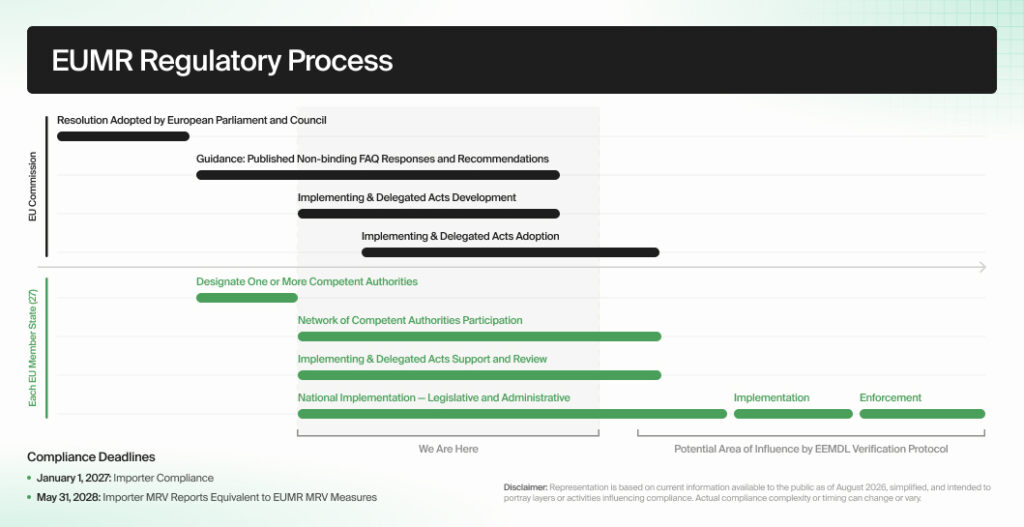
The EUMR regulatory process is multi-phased and complex. The European Commission developed the initial rule and issues the regulation’s implementing and delegated acts, while Member States carry out actual implementation.3 As of the date of this blog, outstanding actions are in process both at the European Commission and national level: the European Commission still must issue the implementing and delegated acts that will clarify rule requirements, and each Member State still must establish national-level legislation and administrative structures needed to enact the rule. 4 The Commission has set up a Network of Competent Authorities EU Methane to foster cooperation on items critical to implementation such as monitoring, compliance and best practices and allow for external consultations.
Member States and their appointed Competent Authorities face a difficult position: they must enact national legislation and establish administrative processes that meet EUMR requirements while they wait for numerous other acts and specifications to be finalized that further specify EUMR requirements. Outstanding items include, among other things, identification of applicable standards for methane quantification in the interim period before standards are developed under Article 32. The regulatory text allows for interpretation in implementation but does not provide additional guidance or interpretation for Member States to add additional specificity to their national regulatory programs. This challenges the Competent Authorities’ ability to add regulatory certainty to the implementation process, particularly in the first years when verification of equivalent monitoring and reporting is required.
Ultimately, Article 12(5) requires operators to use state-of-the-art industry practices, 5 including but not limited to OGMP 2.0 technical documents. Article 9(2) states that operators shall provide verifiers with the standards and technical prescriptions used until relevant standards are established under Article 32. This lends significant discretion to a producers’ choice on what standards and technical prescriptions to use, while OGMP 2.0 technical guidance documents are explicitly stated as allowable documentation. Due to the fit-for-purpose nature of the EEMDL verification protocol and technical reporting annex for interim EUMR conformance, Highwood believes that this documentation has good standing to serve as state-of-the-art industry practice. However, it is the Competent Authorities who will ultimately determine whether reports filed by importers satisfy EUMR requirements.6
Simplified representation of EUMR regulatory process and current state 7
One critical question for verifiers, especially those outside of the EU, remains unresolved: the EUMR requires independent verifiers to hold accreditation consistent with the regulation and the established legal framework for accreditation within the EU. 8, 9 The EEMDL verification protocol outlines how to perform verification under EUMR requirements, but it does not provide a pathway to verifier accreditation beyond citing EUMR Article 9. Ultimately, Member States and their associated national accreditation bodies are responsible for setting accreditation pathways and providing additional guidance if Article 9-aligned accreditation processes are not developed in a timeline consistent with the regulation’s verification requirements.
Recommendations
For energy exporters, commercial market access is both the greatest potential risk and the greatest potential advantage the EUMR presents. Operators without EUMR-compliant programs may risk losing contracts, whereas those with compliant programs may see increased demand for their product. Operators who export to the EU simply cannot afford to wait to establish their methane MRV programs until the EU and Member States resolve all EUMR regulatory uncertainty. The EEMDL Technical Reporting Protocol can further organize methane MRV programs in a manner that allows for assurance to be conducted. Because it has not been formally approved for use, operators using this protocol to develop EUMR-compliant programs accept implicit risk regarding how the regulation is ultimately enforced. However, the technical reporting annex is designed with sufficient binding requirements to facilitate standardized conformance and verification engagements that the EUMR emphasizes.
EUMR compliance process and applicable deadlines
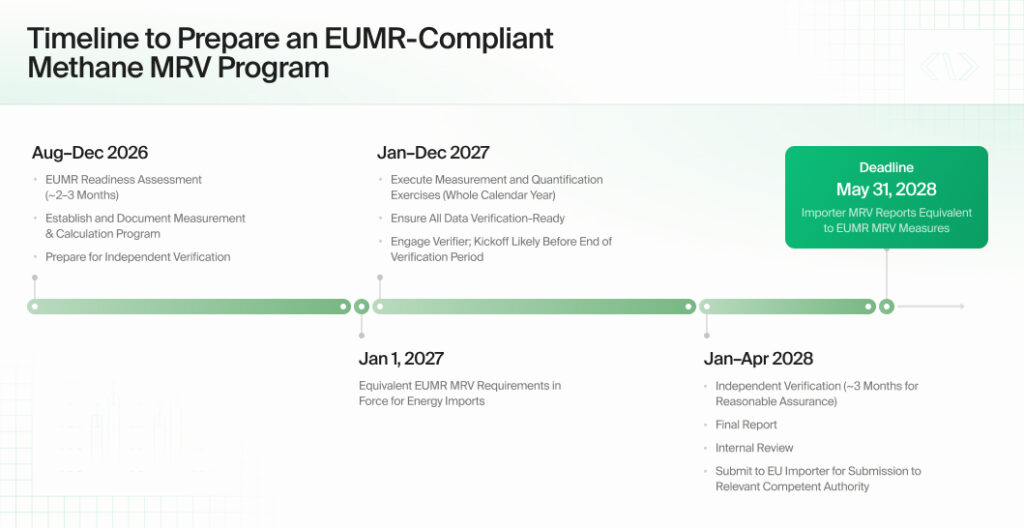
EU importers must submit their first EUMR importer MRV reports covering full 2027 calendar-year production by May 31, 2028. Building a methane quantification program that meets EUMR requirements requires diligent design and quality assurance steps. Producers must:
- Collect relevant source- and site-level emissions data throughout 2027,
- Prepare an emissions inventory that reconciles source- and site-level data,
- Implement data management and quality assurance processes, and
- Develop an emissions report with sufficient detail to support reasonable assurance verification.
There is a lot to do in a very limited amount of time – completing a gap assessment, building a robust monitoring and reporting program, and undergoing reasonable assurance verification require significant time and effort. Producers need to have systems developed by January 1, 2027, to be prepared for a May 2028 reporting deadline.
Although Member States ultimately decide what is state-of-the-art, Highwood views the EEMDL protocol as an important interim tool in developing EUMR-aligned methane reporting programs today while Article 32 measurement and quantification standards are developed.
Highwood’s experts are here to help with your EUMR preparedness questions. Click here to book a conversation with our team.
Sources
1 Tullos, E. 2026. A Protocol for Independent Verification of Methane Emissions of Crude Oil and Natural Gas Placed on the European Union Market. Version 1.0, August 2026. Center for Energy and Environmental Systems Analysis, The University of Texas at Austin, Austin, TX, USA. (European Union Methane Regulation: Verification & Reporting Protocol — CEESA, last accessed August 2026).
2 From Voluntary Initiative to Regulatory Infrastructure: OGMP 2.0 is at an Existential Crossroads (Opinion) – Highwood Emissions Management, Last accessed September 2026.3 Regulation (EU) 2024/1787 Article 4), Regulation – EU – 2024/1787 – EN – EUR-Lex, last accessed August 2026.
4 Olczak, M. 2026. How is the EU Methane Emissions Regulation implemented in practice? Insights from competent authorities and early enforcement experience. June 2026. The Oxford Institute for Energy Studies. (NG-205-EU-Methane-Emissions.pdf, last accessed August 2026).
5 Ultimately, this determination belongs to EU Member State competent authorities.
6 Verification requirements listed in Regulation (EU) 2024/1787 Article 28(5)(a), Regulation – EU – 2024/1787 – EN – EUR-Lex, last accessed August 2026.
7 Adapted from: Olczak, M. 2026. How is the EU Methane Emissions Regulation implemented in practice? Insights from competent authorities and early enforcement experience. June 2026. The Oxford Institute for Energy Studies. (NG-205-EU-Methane-Emissions.pdf, last accessed August 2026).
8 Regulation (EC) No 765/2008, Regulation – EU – 2008/765 – EN – EUR-Lex, last accessed August 2026
9 Regulation (EU) 2024/1787 Article 9), Regulation – EU – 2024/1787 – EN – EUR-Lex, last accessed August 2026.